
HIVE / THE JOURNAL
DAIKOKU
AFTER HOURS.
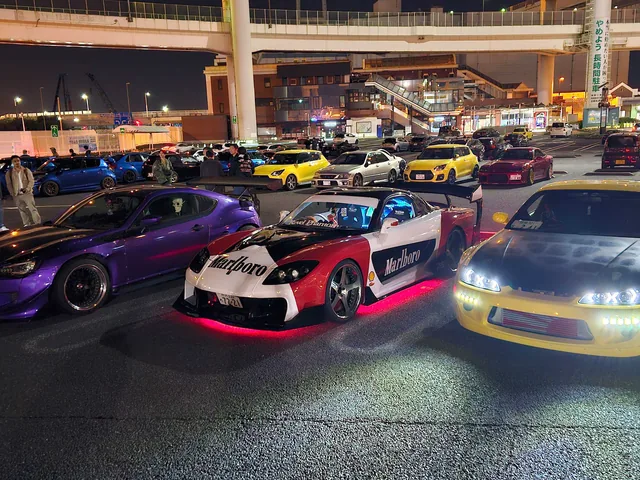
The ramp off the Shuto lets the city thin out without letting it go. Daikoku Parking Area sits on the bay side of the road, a loop of asphalt between the water and the elevated lanes, and on a clear night the cranes show themselves before the cars do. I take the window down for the last stretch. The air smells like tide and warm brakes. The passenger goes quiet in the way that means the night has started.
You hear the lot before the rows line up. It is an uneven idle, engines warm and then left to sit. A straight six on the left. A smaller motor from the far row. A door shuts. Someone laughs once, and the laugh goes under a cooling fan. After dark this parking area becomes a room. The painted lines are still for parking. The people in them are in no rush to leave.
I switch the engine off and the cabin ticks. We step out onto ground that still holds the day's heat. The first row refuses one theme. An old coupe with a lip that has seen more than one winter. A newer sedan, paint holding the floodlights in a single sheet. A wagon sitting square, as if coffee had been the excuse and the rows were the reason. People walk the aisles like a market. Slow. Hands in pockets. Eyes on details a roadside photo never keeps.
The rhythm is simple, and the lot keeps it. You park. You walk. You look. A hood up means you wait at the edge of the talk until there is space. A hood down means you read the stance, the wheels, the light on a fender set a little wider than the factory planned. The car says the sentence. The people around it supply the tone.
Wind nights and still nights feel different on the skin and the same in purpose. Questions hang in the air without being asked out loud. What is that intake. Who built the exhaust. How many seasons has this one been driven. You learn a car by what was left alone. A careful cabin with a tired bumper is one history. A tired cabin with a careful bumper is another. Both drove here. Both fit the row.
The courtesy out here is attention. A question, when it comes, is about a part or a choice, and the answer is usually short because the car has already been honest. Between two bumpers a conversation can finish with a nod and send both people back to walking the row.
Above the lot the expressway continues, white light one way and red the other. Those cars are still going somewhere. The cars below have arrived. That is the mood of Daikoku. A pause with an engine in it. People check the time and stay. A couple leans on the rail and watches another row fill. A driver wipes a mark from a door, sees it gone, and wipes the door again.
On the second loop a Skyline faces the water, the old shape you can name before you can read the badge. Beside it sits something newer and wider, sodium light breaking along the paint in a hard line. I let the names rest. The feeling is the point: standing between them while the lot becomes a temporary city. A new car comes down the ramp. Headlights sweep. Heads turn the same small degree. Arrival is the greeting.
The service building is bright, ordinary, a little too clean for the scene outside the glass. I like that contrast. Travelers buy snacks and check maps. Out in the rows, someone young walks the length of one line twice, memorizing. I recognize the walk. The scale of this lot is big. The reason for the walk is old. You come to see care made visible, and you leave with a thought you will not call a plan until your own garage.
HIVE nights bend here because the drive is already part of the story. Streets, then the elevated road, then the bay opening beside you. Towers drop behind. The horizon goes industrial, then dark. By the time we roll in, our car is scenery too. The night works as a sequence of rooms, and this is the room where motion stops long enough to be studied.
We stay until one corner feels known. You learn which pole shadows the third row, which way the wind jumps when a truck passes overhead, the soft shut of a door whose owner trusts the latch. I lean on our car and let the passenger take the last loop alone. The lot teaches its own pace better than I can.
We idle out the way the other cars do, merge, and watch the gathering shrink to a glow in the mirror. The cabin is calmer than the ride in. That calm means the stop worked. A taillight, a conversation almost joined, the surprise that a famous place can feel like a neighborhood after the day gives up. Daikoku has not been a secret for years. On the right night it is still a meeting: cars, people, the bay at the edge of the asphalt, and time enough to recognize care in a machine. The idle stays in the ears a little longer than the road. That leftover is what I hope they keep.
Book a tour now ↗