
HIVE / THE JOURNAL
UMIHOTARU
AFTER HOURS.
Umihotaru feels unlikely until you are standing on it. The Tokyo Bay Aqua Line runs from the Kawasaki side toward Kisarazu, bridge and then tunnel, and the middle of that crossing is an island built so people can stop. At night the stop outgrows its map. Water on every side. Wind with only cars and railings to catch it. A sky the city has not filled.
I time the drive for full dark. Bridge lamps repeat in a clean line. The bay under them is black, a few working boats, mostly empty. Road noise in the cabin loses the city. The passenger goes quiet without a prompt. Headlights cover the next piece of deck and then quit, and the lamps and the water take the rest.
The island shows up as a brightening. Wider deck, a building, a lot painted on ground that replaced open tide. We park facing the water when we can. The view is the pleasure. The pause is the point. Without this place the crossing would be one uninterrupted shot from shore to shore. Here you have to admit you are in the middle.
Wind is the first fact outside the door. It crosses the bay without softening. Hair, jacket hems, an unweighted napkin. Salt, and under it the hot metal smell of cars that arrived earlier. Turn in a circle and there is no back wall. One horizon is the dense shore, towers and port light stacked. The other is lower, longer, farther looking than the map. The bridge behind you shrinks to a diagram of white points.
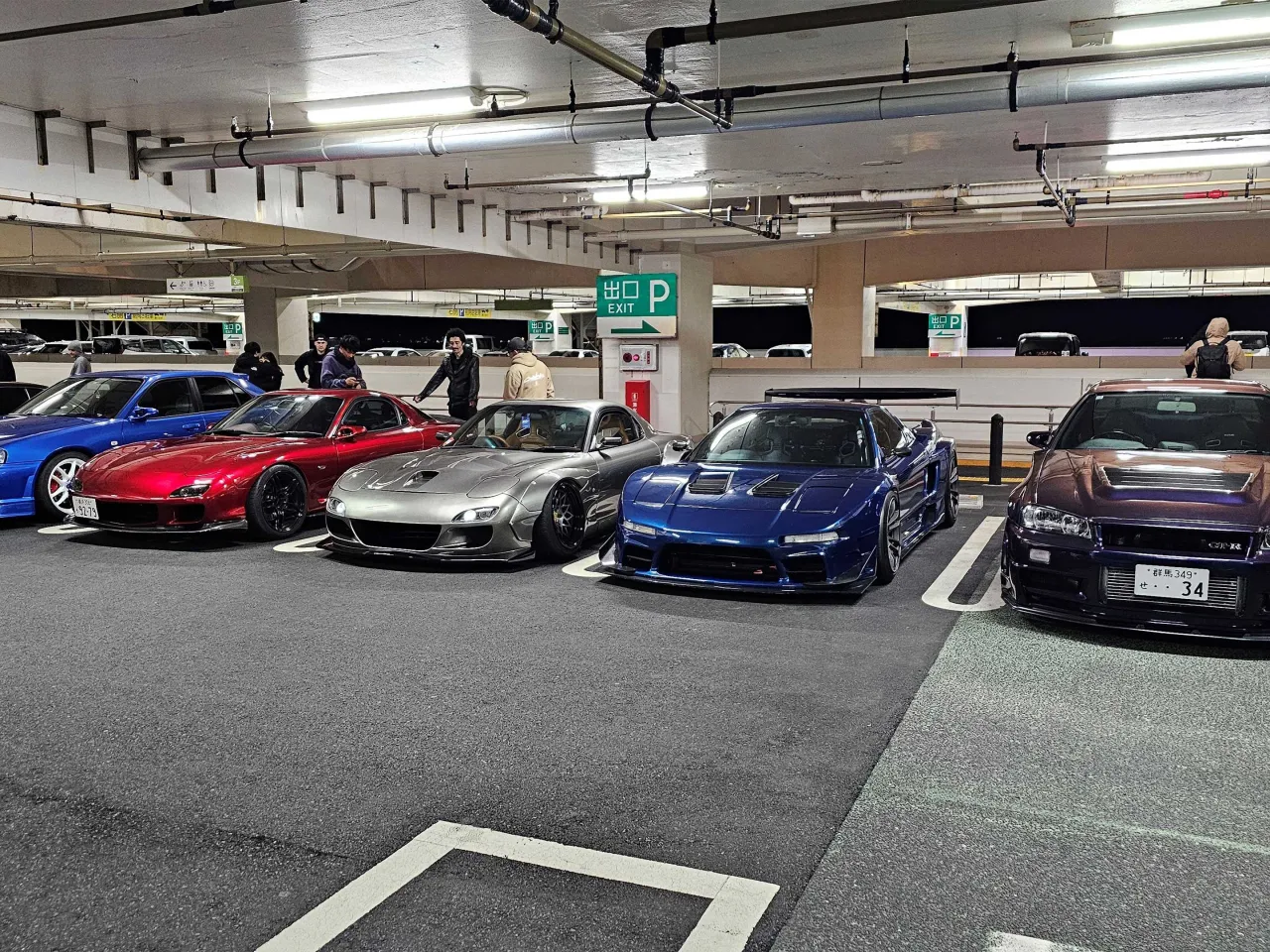
Cars gather for the view and for one another. A coupe that seems made to sit against water. A family van with no interest in the scene. A sedan whose exhaust you hear only when the wind dips. People stand at the rail with their backs to their own cars. The machine can wait. The bay will not repeat the same picture.
A particular quiet shows up when a car idles here and then goes still. Bay noise replaces it: wind, a distant hull, the thin electric hum of the plaza. People talk more softly than they did on the bridge, as if the water could overhear. That courtesy holds the gathering, even when the rows are busy and another set of headlights climbs onto the island.
At the edge we let a minute stay empty. A ship looks parked until a far shore light proves it is moving. The tunnel mouth is a darker choice in the dark. The road was engineered, and it also became a place to look from. Tickets, restrooms, food, and a view were the assignment. The night crowd treats the rail like a balcony. Vending machines hum. A door slides. A shutter click loses to the wind.
I wait for the second minute, when the phone comes down and the shoulders drop. The first minute is often a pose aimed at the skyline. Umihotaru is better after that. The scale makes posing feel small. You are small. The bay is not. The car that brought you is one bright shape among others. It matters, and it sits inside a much larger dark. The toll buys that feeling.
Walking the rows, I point less than a host is expected to. Talk can step in front of a view that is still arriving. Details do better on their own. A taillight in the paint beside it. Three friends rotating the outside spot at the rail. An older driver, arms folded, the rest pose of someone who has stopped here often and still likes the first look. A nod if one is offered.
The building is useful and ordinary. Bright floor, coffee, fried food, children who slept the bridge and woke to the word island. If the wind has teeth I buy something warm and we go back out. The cup cools immediately. That is the report from the bay. Heat does not survive the doorway for long.
A HIVE drive through here is a lesson in distance. Tokyo at night is neighborhoods, pocket after pocket of light, endless and local together. The crossing breaks that. A horizon appears. The body remembers the city is on water, the water has a middle, and the middle has a parking area named like a small light. Umihotaru. Sea firefly. You feel it before a translation.
Leaving is a mood. Back to the dense shore, towers rebuilding in the glass. Or into the tunnel, where the wind ends at once and the world becomes lamps, tile, and our own car. I like the tunnel after the island. The balcony is behind. The next quiet has to be earned. People look back even when the glass shows only road. The look is the souvenir.
We merge. The island becomes a cluster of lamps, then one lamp, then wind remembered on the hands. The cabin warms. Someone says the middle of the bay felt like a room with the roof removed. I let the sentence stand. Some nights the passenger finds the line, and the work was to drive them to the spot where it could be said. Full rows, talk, arrivals under a huge sky: the gathering is real. What lasts is the position, held between shores, weather on you, the road patient until you are ready.
Book a tour now ↗